How the Coolidge became one of four theaters in the world to screen in VistaVision
Originally published Sept. 26, 2025 in the Boston Globe
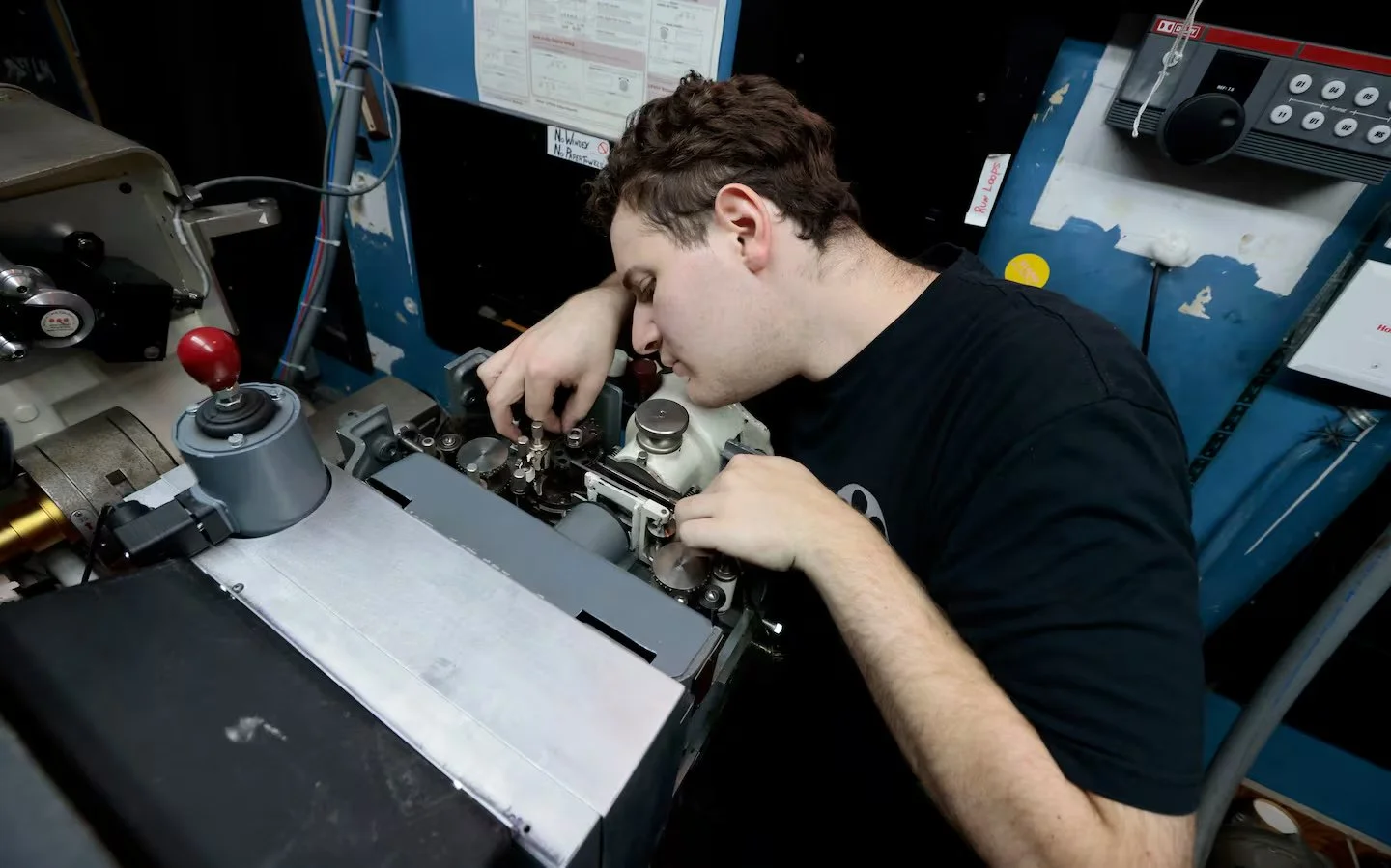
When Paul Thomas Anderson and Warner Bros. ask for a movie to be screened in a projection format out of use since the 1960s, you deliver.
The past week has seen the Coolidge Corner Theatre retrofitting one of its rooms to support widescreen VistaVision viewings of “One Battle After Another,” the new Anderson film starring Leonardo DiCaprio. Though a widescreen film format is far from an anomaly today, VistaVision hasn’t been used in both the filming and physical projection of a feature film since 1961, given how difficult it is to source its specialty projectors. The Coolidge will be one of just four theaters around the world capable of showing the film that way, and moviegoers can see it at the theater through Oct. 21 (additional screenings will on sale on the Coolidge site soon).
“It’s an incredible opportunity to see this format that was written off as an antiquity back and coming to life in a movie house filled with 400+ people,” Mark Anastasio, program director at the Coolidge Corner Theatre, said. “It’s going to be a sight to see.”
Developed in the 1950s by Paramount, VistaVision flips 35mm film on its side and runs it horizontally through the camera. This creates a negative image about double the size of one captured on a standard film strip, which leads to a high resolution projection. Warner Bros. called the Coolidge two weeks ago to pitch the idea, after announcing VistaVision screenings at three other venues in New York, Los Angeles, and London.
For the theater, it was exciting in that it reaffirmed Anderson’s love for the Brookline institution. The director’s affection for the theater dates back at least to the release of his 2012 film “The Master,” when he paid a visit to the arthouse cinema and added it to a personal list of venues with the ability to properly show films in 70mm. This list, Anastasio said, made its way around Hollywood, and helped spark a renaissance in 70mm releases nationwide, thus landing the Coolidge more opportunities to screen these films.
Anastasio said the director has occasionally kept in touch since then.
“There are days where suddenly, a 35 millimeter print will show up from PTA’s office, and it just has a little note attached to it that says ‘Here’s a new video I shot, would you consider running it before feature films?’” he said. “I know that we’re on his radar as a great film institution.”
Sean McKinnon, Director of Specialty Presentations at Boston Light & Sound, which helped facilitate the installation of VistaVision equipment, confirmed Anderson helped drive the VistaVision screenings at the Coolidge.
“I was told from Paul’s team that they really wanted to do it at the Coolidge because it’s one of his favorite theaters,” he said.
The prospect of screening in VistaVision in 2025 is an exciting, albeit nerve-wracking process, given all of the logistical scrambling that goes into setting it up. VistaVision, according to McKinnon, is one of the most uncommon film formats, and functioning VistaVision projectors are even rarer. McKinnon said that even back in the ’50s, its primary use was to shoot quality film rather than both shoot and project it.
“It was never really intended as a projection format,” McKinnon said. “So even in its heyday, it was rare.”
Boston Light & Sound had access to a projector on loan from the George Eastman Museum in Rochester, NY, which the museum had previously received from Boston Light & Sound’s founder Chapin Cutler. This projector, discovered in a Dallas warehouse in 1984, is believed to be an original prototype built for Paramount.
The connection between a Boston-based company with access to a rare piece of equipment and Anderson’s previous experiences with the Coolidge made the theater an obvious fit for Warner Bros. to set up a a showing here — as did the Coolidge’s massive movie screens, which could properly host the larger projection.
But adjustments were still needed. The projection booth hadn’t wasn’t equipped to host the cumbersome machine running the VistaVision film. McKinnon estimated the machine’s dimensions at five feet tall by seven feet wide by three feet deep on the high end, with a cast iron base. It’s so large that Boston Light & Sound needed to call in movers to remove many pieces of equipment from the Coolidge’s projection booth — much of which had been there for decades. There have also been more permanent modifications to prepare the space.
“Electricians [were] here in the building literally drilling through the floor to install a new power supply for this particular machine,” Anastasio said.
The toiling to accommodate one film in an archaic format that’s only playing for a couple of weeks may seem like too much work for the payoff, but Anastasio rejects that notion. He highlighted not just the staff’s appreciation of film, but the people who frequently come out and support specialty screenings at the theater.
”We jumped at the chance to do it because we know that our audience will appreciate it,” he said.
It’s also another opportunity to promote the city as a global hotspot of cinema.
“There’s also something really cool about putting Boston on that specialty film map along with places like New York, Los Angeles, and London,” he said. “We belong alongside those other places.”