One year after controversial ‘Rooted’ installation removed from Northeastern campus, scars remain
Originally published Jul. 29, 2026 in the Boston Globe
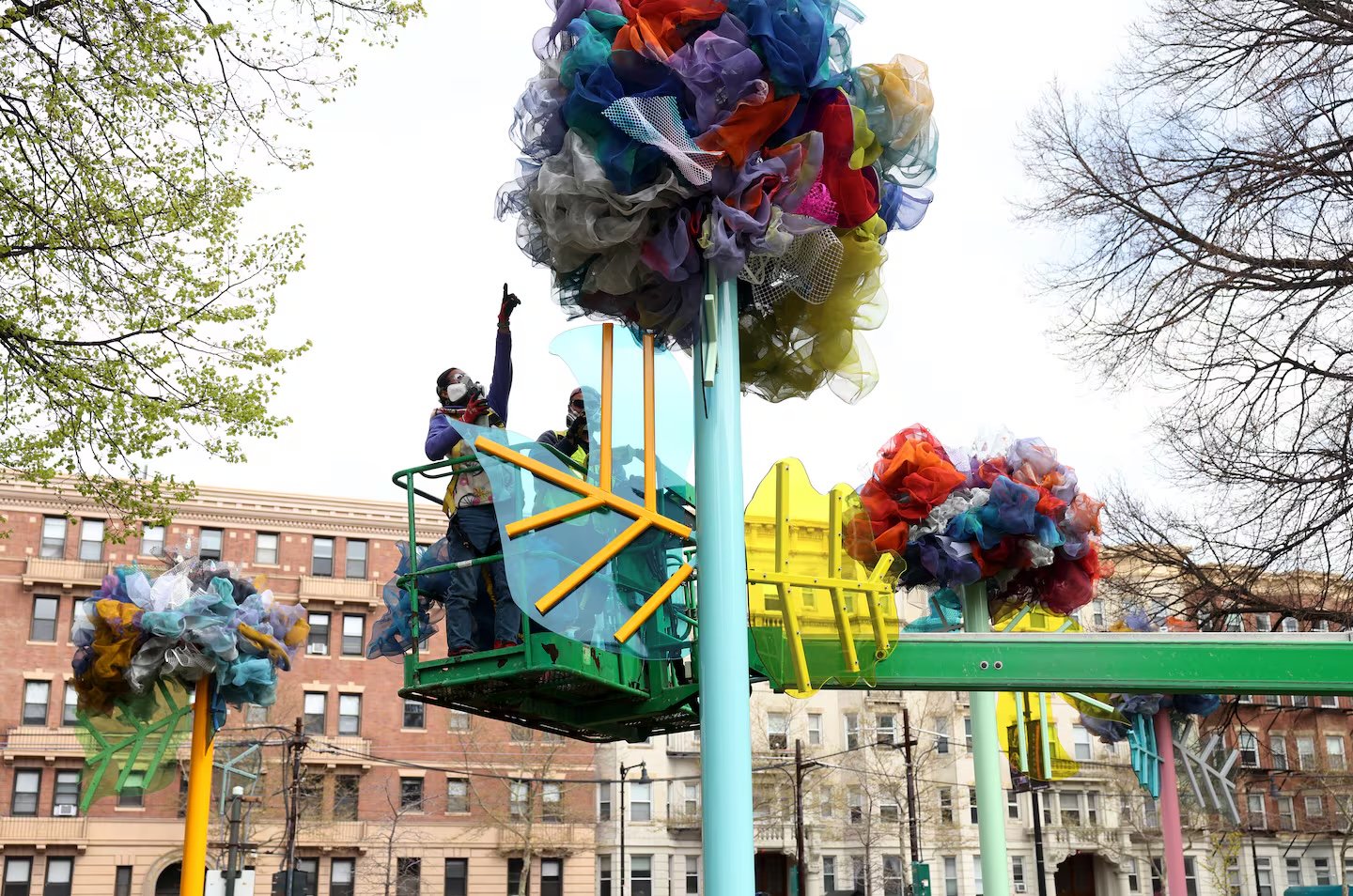
Artist Cicely Carew could sense a disconnect as she was installing her colorful new sculpture, “Rooted,” on Northeastern University’s campus in 2024.
“I remember this one guy coming up to one of the install people, and he’s like, ‘What is this?’,” she said. “We said, ‘Well, it’s a public art installation, it’s for the quad, it’s gonna be here for a couple years.’ And he’s like, ‘Well, no one told us about this.’”
In hindsight, it was a warning of what shortly was to come. Upset by the sudden and unexplained appearance of the installation — a sculpture garden of massive flowers made of wire mesh, plexiglass, and steel — students revolted. The vibrant colors clashed with the white-brick architecture of Krentzman Quad, where the flowers were installed, they said. Worse, many felt, it defiled a view that for years was a traditional backdrop for graduation photos. Outrage quickly spread. A petition was circulated, a vote by the student government taken. And in April last year, the “Truffula Trees” (of the Dr. Seuss classic The Lorax), as they were derisively nicknamed, were quietly removed after just a year in place.
The controversy has left scars.
“I was left out in the cold, and I have carried this with me since,” the artist said.
In its wake, however, may be lessons for public art. Northeastern University declined to comment, but some of the actors in the drama now say the dispute was less about artistic merit than it was about the perception that the art was being foisted upon its audience without allowances for input.
“Public art is art work that people have to live with every day in their day-to-day lives,” said Thomas Vannatter, the former public art manager at Northeastern who initially brought Carew in for a visit. He left the university in late 2023, before any meaningful installation work began. “The more you can engage them in either the process or just let them know what’s going on, the better they’re going to feel about it.”
It didn’t help that the new installation appeared shortly before 2024’s spring commencement.
“The most potent reaction right away was definitely from those students graduating who felt like their planned classic spot for a photo was now being altered,” said Julian Herzing-Burkard, a Northeastern alum who was last year’s student body president.
The chief complaint among students was the installation’s location. A poll taken by the Student Government Association in 2024 found that respondents were far more critical of the art’s location than of the art itself.
Carew was unaware of these concerns until the project was far down the line.
“It wasn’t meant to upset them or take the signage away or ruin their graduation photo,” she said. “That’s a crazy assumption, but that was the sentiment.”
Herzing-Burkard, who was involved in student government every year he was at Northeastern, proposed a resolution on Oct. 28, 2024 that called on Northeastern to remove or relocate “Rooted” and work with students on future public art installations. It passed without any “no” votes and little deliberation, he said.
The tension on campus has been more or less resolved, and graduation photo-ops are back to normal, but both sides still feel scorned by the lack of communication offered by Northeastern about the installation. To students, “Rooted” arrived with little notice and no time for their concerns to be aired before it was too late. This was reflected in the student government’s initiative calling on the university to consult with students ahead of future public art installations.
Herzing-Burkard said he didn’t see this part of his proposal come to fruition.
“ I think there was a lot of focus on removing the art installation and momentum was a bit lost in that process,” he said.
To Carew, the lack of communication about her work — in terms of its purpose and presence — rendered the artistic intent irrelevant. This perspective is shared by Vannatter. The two pointed to his departure as a turning point in the project, leading Carew to interface with Northeastern’s marketing team rather than public art curation team. The aims became much more deadline-focused, and caused Carew’s timeframe to be crunched. The sculptures were installed a few weeks before commencement, and Carew’s plan on a methodical installation where she could make any meaningful alterations went out the window.
That focus on meeting a deadline, Vannatter said, led to the university taking shortcuts on informing the student population that a stark visual change was coming. This could have been achieved through mass marketing materials, artist talks, or plaques on campus explaining the arrival and purpose of the work, he said.
“With the focus on ‘gotta get it done by commencement,’ you’re very much focused on the project and not as focused on what may at the time seem ancillary,” he said. “But when you boil it down, it is kind of necessary.”
Carew still is hurt by the ordeal, and harbors ire toward the university. But her ego was never bruised by comments about her sculptures’ appearance. “I love ‘The Lorax,’” she said. And she wants another crack at large public art projects on university campuses.
She just hopes that, for everyone’s sake, communication takes precedence.
“That would’ve changed the first take of ‘Ugh, it’s a ”Lorax" tree’ to ‘What am I looking at?’,” she said. “‘If I hate it, why do I hate it so much?’”